Is your site showing up when AI recommends products?
You can't rank what AI can't read. When a shopper asks ChatGPT “where can I buy X?” or asks Perplexity to recommend a product, does your site appear? Most don't. SEOLZ asks ChatGPT, Perplexity, and Google's AI — live — whether they recommend you, and shows exactly which competitor they name instead, per engine.
Free to check. No credit card. Results include ChatGPT + Perplexity mention counts, AI-crawler status, and entity presence.
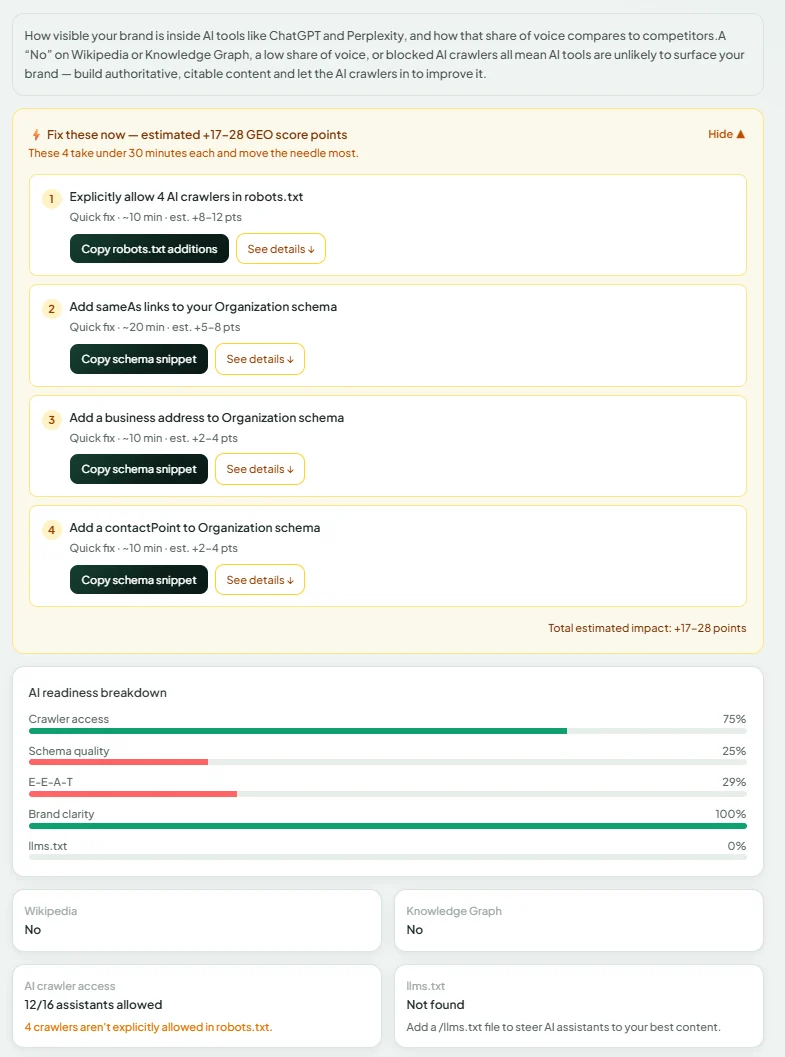
Your live GEO results — AI-crawler access, an AI-readiness breakdown, and the exact fixes to get cited.
Search is no longer just Google.
of Google searches end without a click as AI answers the query directly.
of US searches now trigger an AI Overview in Google results.
higher click volume for brands cited inside AI answers vs those that aren't.
When a shopper asks ChatGPT to recommend a store in your category, the AI doesn't run a search. It pulls from what it already knows and what it can read right now — and it recommends the brands it trusts. If your site isn't in that answer, your competitor's is. Getting cited is the new version of ranking on page one.
Generative Engine Optimization (GEO) is what makes your store citable to AI systems. It's not keyword stuffing or guesswork — it's fixing the specific technical barriers that keep AI crawlers out, adding the structured data AI engines use to understand your products, and building the entity signals that make AI systems trust you enough to recommend you.
Underneath all of it: an AI can only cite what it can read and trust. The same semantic structure that makes a page accessible is what lets an answer engine extract it, and the same security signals that keep your store safe are what let it trust you. You can't rank what AI can't read.
What SEOLZ's AI visibility sweep checks
AI crawler access
We check your robots.txt against 10 named AI crawlers including ChatGPT (GPTBot), Perplexity (PerplexityBot), Google AI (Google-Extended), Anthropic (ClaudeBot), Amazon (Amazonbot), and more. If you're blocking them, you're invisible to AI.
ChatGPT, Perplexity & Google AI mentions
We ask ChatGPT, Perplexity, and Google's AI — live — prompts relevant to your site's category, and track whether your brand appears in the answers, and how often.
Who's cited instead of you
For every engine we query, SEOLZ records which competitor it named instead of you — the domain, its rank, whether it's you. If a rival is winning the AI answer in your category, you'll see exactly who, on which engine.
Entity presence (Knowledge Graph)
AI engines trust brands with established entity signals — Wikipedia presence, Google Knowledge Graph entries, consistent brand mentions across authoritative sources. We check where you stand.
Schema for AI readiness
AI engines rely heavily on structured data to understand your products. We check Product schema, AggregateRating, FAQPage, BreadcrumbList, and E-E-A-T signals — the markup that makes your pages AI-citable.
AI visibility trend
We track your AI mention counts over time so you can see whether your improvements are working — or whether a competitor is pulling ahead.
What your AI visibility score means
AI assistants are unlikely to recommend your site. Critical blockers detected.
Partial AI visibility. Competitors with better GEO are getting recommended instead of you.
Your site is AI-readable. Refine schema and entity signals to increase citation frequency.
Your site appears regularly in AI recommendations for your category.
How to improve your AI visibility
Fix your robots.txt
Allow the major AI crawlers. Blocking GPTBot and PerplexityBot means those AI systems literally cannot read your site. This is the fastest fix.
Add structured data
Product schema, AggregateRating, and FAQPage markup are the primary signals AI engines use to understand and cite your pages. Missing schema = missing citations.
Build entity presence
AI engines trust brands that appear across authoritative sources. A Wikipedia entry, Google Knowledge Panel, and consistent brand mentions signal trustworthiness to AI systems.
SEOLZ identifies every GEO blocker on your store — robots.txt violations, missing schema, crawler access gaps — and gives you the exact fix for your platform, including paste-ready code. We've got you.
Your competitors may already be showing up. Find out where you stand.
Free GEO sweep included with every scan. See your AI mention counts, crawler status, and schema gaps — before you upgrade anything.
And it doesn't stop at the scan — on a paid plan SEOLZ keeps watching, and tells you the moment a competitor takes an answer you used to hold. See what SEOLZ watches →
Check my AI visibility →Frequently asked questions
What is AI visibility for ecommerce stores?+−
AI visibility refers to how often and how prominently your store appears when AI assistants like ChatGPT, Perplexity, or Google's AI Overviews recommend products or stores in your category. As more shoppers use AI to discover products, AI visibility is becoming as important as traditional search rankings.
Why isn't my store showing up in ChatGPT or Perplexity?+−
The most common reasons are: (1) your robots.txt is blocking AI crawlers, (2) you're missing structured data that AI engines use to understand your products, (3) your brand lacks entity signals that AI systems use to establish trust. SEOLZ's GEO sweep identifies exactly which applies to your site.
What is GEO (Generative Engine Optimization)?+−
GEO is the practice of optimizing your store to appear in AI-generated answers and recommendations. Unlike traditional SEO which targets search-engine rankings, GEO targets the AI systems that increasingly answer shoppers' questions directly — without showing a list of links.
Which AI engines does SEOLZ check?+−
SEOLZ checks your visibility and crawler access for ChatGPT (OpenAI), Perplexity, Google AI Overviews (Google-Extended), Anthropic Claude, Amazon (Amazonbot), Apple, Meta, and more — covering the major AI systems shoppers use to discover products.
How is AI visibility different from SEO?+−
SEO optimizes for search-engine rankings — position in a list of links. AI visibility optimizes for citation — being the source an AI system recommends when a shopper asks a question. The underlying signals overlap (structured data, authority, quality content) but the goal and measurement are different.
Find out if AI is recommending your competitors instead of you.
Free scan. No credit card. GEO sweep + five other pillars.
Check my AI visibility →